How to build a feedback system that really impacts the business: Arsenal Insurance case study
In today's competitive environment, customer service quality can become the decisive factor in a business's success or failure. Customers expect not just a product or service, but a complete experience — from first contact to after-sales support. That is why the feedback question goes far beyond a formal survey and becomes a strategic management tool.
Many companies believe that feedback is only needed "for the record." But practice shows: the deeper a business works with its customers' opinions, the more resilient it is in the long run. And this is particularly important in the insurance sphere, where trust and support in difficult situations are of key importance.
This is exactly the path taken by Arsenal Insurance, which built a systematic feedback ecosystem together with Revisior.
About the company
Arsenal Insurance is one of the leaders in Ukraine's insurance market, consistently ranking in the TOP-3 in the CASCO segment and TOP-6 by gross insurance premium volume. The company has been operating since 2005 and serves thousands of private and corporate clients across the country.
The company's focus is on technology, speed of response and continuous 24/7 client support. For such a business it is critically important not only to resolve insurance cases, but also to understand how customers perceive every stage of interaction.
Problem: why traditional approaches no longer work
At a certain stage of development, the company's management realized: traditional methods of collecting feedback no longer provide a complete picture.
There were individual signals, but they did not answer the main question — how much customer service actually impacts business development.
Key challenges
Fragmentation of data
Customer feedback existed in various channels:
- website inquiries,
- calls to the hotline,
- reactions after payouts,
- public mentions in media.
This data was not combined into a single system, and therefore did not answer the question of where exactly problems arise and how to improve them.
Absence of real-time feedback
Delayed reactions meant that the business would learn about a problem when the customer had already formed a negative opinion.
HR factor
The company understood: the internal state of the team directly affects the quality of service for customers. But there was no tool that would allow honestly measuring employee loyalty and understanding what troubles them.
Reputational risks
Without systematic monitoring of brand mentions, the brand risks losing control over the information field, which directly affects the trust of clients and partners.
Theory: why feedback is not about ratings, but about management
Many companies ask: can a simple review system really impact business?
The answer is — it can, if it is built correctly.
1. Feedback as a service improvement tool
Every review is a signal. If a business ignores it, the customer looks for an alternative. If the business responds — an opportunity arises to:
- improve the process,
- retain the customer,
- increase loyalty,
- reduce churn.
2. Closed-loop feedback
The key principle is a closed loop:
- Customer leaves a review
- System records the signal
- Team receives a notification
- A reaction takes place
- The customer is followed up with a resolution
It is precisely this approach that allows not just collecting user opinions, but transforming them into real changes.
Solution: "Voice of Customer and Team" ecosystem
Together with Revisior, the company implemented a comprehensive system that unified external and internal feedback.
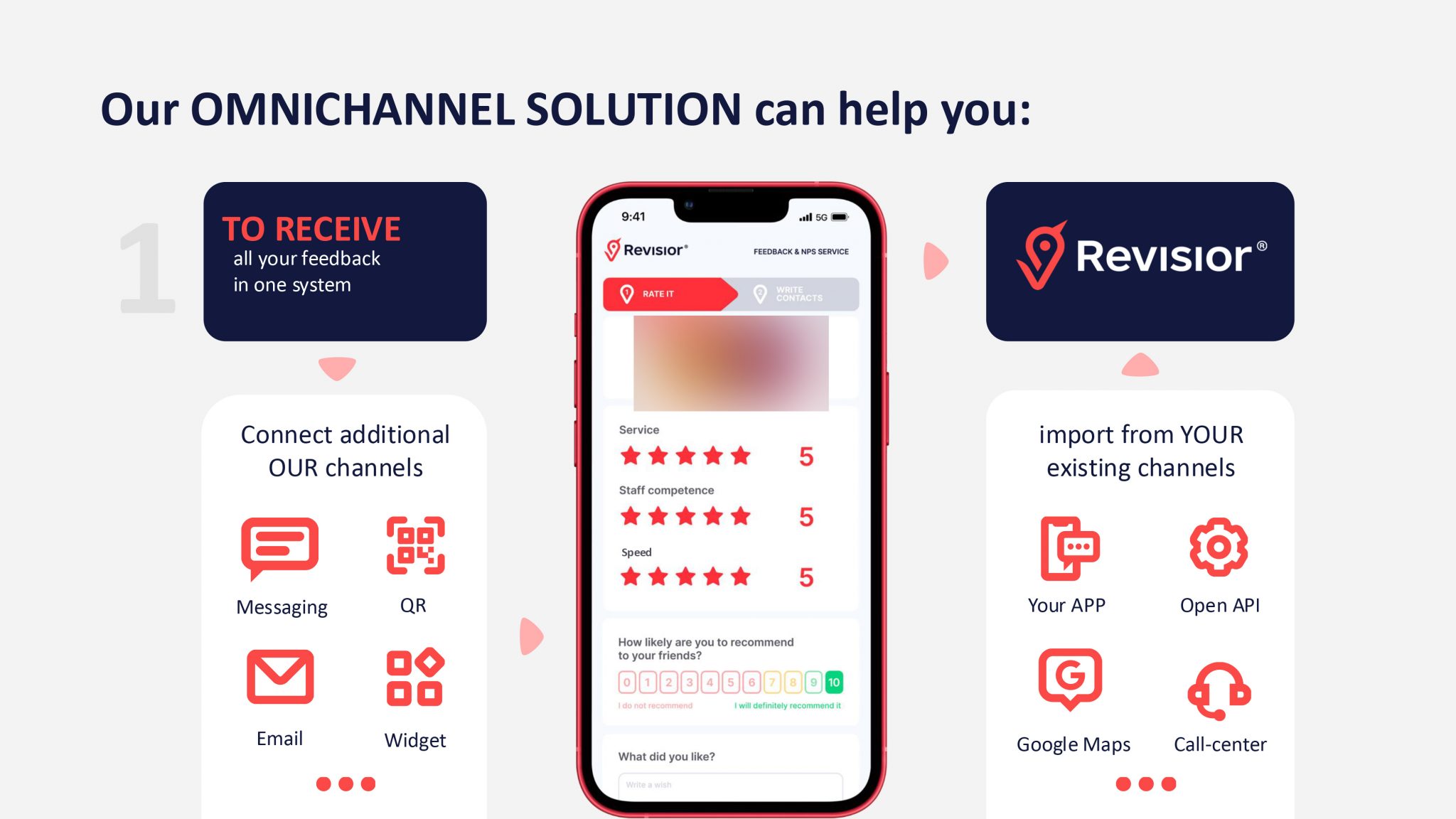
1. Collecting feedback via website and Viber
An NPS button appeared on the website, allowing customers to rate:
- ease of use of services,
- consultation quality,
- clarity of information.
This made it possible to improve the user journey even at the first stage of interaction.
After insurance payouts, customers automatically receive a Viber survey. It is at this moment that customers are most honest, since the service outcome is already known.
2. Information monitoring and media analytics
For the insurance business, reputation is a critical asset. Revisior provided:
- automatic monitoring of mentions in media, social networks and forums;
- AI sentiment analysis;
- historical analysis of over 11,000 mentions since 2019.
This allowed the company to clearly understand:
- how the brand is perceived by customers,
- which topics cause tension,
- where communication support is needed.
3. eNPS: feedback from the team
To improve service for customers, it is important to first understand the state of your own team.
An anonymous employee survey was conducted, which showed:
- strong points of corporate culture,
- growth areas,
- level of trust in management,
- factors affecting motivation.
This data became the foundation for HR decisions and internal support programs.
Results: how the system impacts business
The implementation of Revisior gave the company not abstract feelings, but measurable results.
Unified analytics
All data — client, reputational and HR — is collected in a single dashboard. Management sees the complete picture and can make decisions quickly.
Prompt response
Every negative review became a trigger for action, not a statistic "for later."
Service improvement
The company recorded stable positive dynamics in ratings and growing customer trust.
Reputational resilience
Systematic monitoring provided control over the information field and reduced the risk of crises.
Why this matters for your business
The Arsenal Insurance case shows:
feedback is not about formal surveys, but about managing service quality, support and trust.
If you want to:
- understand how much service impacts customer retention;
- improve the user experience at every touchpoint;
- unify customer and team opinions into one system;
- gain more loyal customers and less negativity;
— you need not just a review form, but a complete feedback ecosystem.
Conclusion
The Arsenal Insurance case is an example of how a business can transition from intuitive service management to data, analytics and real improvements.
Revisior helped the company:
- hear its customers,
- understand its team,
- ensure support quality,
- transform feedback into a strategic asset.
«Revisior helped us see insights where others only hear silence. This is the most valuable thing a business owner can receive», —
Maryna Avdyeyeva, Managing Shareholder of IC «Arsenal Insurance»
Want to find out how such a system can work in your company?
Order a personal Revisior demonstration — and we will show you how feedback can improve service, support and results for your business.