Why customer satisfaction level determines a company's success
Customer satisfaction level is a key indicator that directly affects the stability and development of a company. Consumer experience determines whether they will return, whether they will recommend the company to others, and whether they will remain loyal in the long term. According to PwC data, 73% of buyers consider the service experience a decisive factor when making a purchase decision. Growing competition and market openness are forcing businesses to pay ever more attention to the quality of customer interactions, since both profit and brand reputation depend on this.
Impact of satisfaction on business metrics
Customer satisfaction level significantly affects a company's financial results. According to the classic Bain & Company study, increasing customer retention by 5% can increase profit by 25–95%. A high level of satisfaction, in turn, stimulates repeat purchases and increases the share of loyal customers. For clarity, below is an illustrative example of the correlation between indicators:
Indicator |
High satisfaction |
Low satisfaction |
Customer loyalty |
85% |
45% |
Average check |
+20% |
-15% |
Satisfied consumers are willing to spend more and more frequently recommend the company.
Why customer experience has become critically important
The modern consumer expects not just a quality product, but impeccable service. Customer experience research consistently shows: a negative experience is one of the main reasons for rejecting a brand, and a significant portion of consumers are ready to switch to a competitor after just a few unsuccessful interactions. Consumer experience covers all touchpoints — from first contact to after-sales support. The main reasons for the growing importance:
- Competition — new players offer higher service levels.
- Review accessibility — negative information spreads quickly.
- Increased demand for personalization.
How modern companies work with feedback
Leading companies are actively implementing digital platforms for collecting and analyzing feedback. An increasing number of companies are regularly — quarterly or more frequently — reviewing interaction strategies based on the reviews received. The most effective approaches:
- Implementing online surveys and chatbots for rapid response.
- Regular analysis of social media and reviews on external platforms.
- Using automated systems for personalized communication.
Systematic work with feedback allows maintaining a high level of customer satisfaction and identifying problems in a timely manner.
Basics of measuring customer satisfaction
For modern businesses, customer satisfaction surveys have become an integral tool for collecting feedback and improving service. These studies allow companies not only to quantitatively assess the level of consumer loyalty, but also to respond to problems promptly. Measuring customer satisfaction is based on the use of special metrics such as CSAT and NPS, which provide an objective comparison of results across different industries. Detailed analysis of the data obtained helps identify weak points in audience interaction and form strategies for increasing loyalty.
What is the customer satisfaction score (CSAT)
CSAT (Customer Satisfaction Score) is a basic metric that reflects the percentage of customers satisfied with a specific product or service. Surveys are usually conducted in the form of short questionnaires with a rating from 1 to 5 or 1 to 10. According to Zendesk data, the average CSAT worldwide is 85%.
- A high CSAT indicates quality service
- A decrease in the indicator may signal growing dissatisfaction
Types of surveys for evaluating consumer experience
Various types of customer satisfaction surveys are used for data collection, from short SMS surveys to detailed online questionnaires. The most common formats:
- CSAT — evaluation of a specific interaction.
- NPS — readiness index to recommend the company.
- CES — difficulty of receiving the service.
The choice of type depends on the research goals and audience characteristics.
Interpreting CSAT and other metric results
Interpreting CSAT and NPS results helps see the overall picture of customer satisfaction. For example, CSAT above 80% is considered a good result, and NPS from 50 points is a sign of strong loyalty.
Metric |
Good result |
CSAT |
80–90% |
NPS |
50 and above |
Regular interpretation of data allows quickly responding to changes in customer sentiment.
Developing effective surveys for collecting reviews
Customer satisfaction surveys allow not only identifying strengths and weaknesses of service, but also ensuring continuous improvement of interaction with the target audience. Well-structured questions contribute to obtaining accurate and useful feedback, and using various communication channels increases respondent coverage. A good choice of format and flexibility in survey design ensure maximum effectiveness of information collection for analysis and subsequent company improvements.
Key questions for evaluating the satisfaction level
Effective customer satisfaction surveys are based on specific questions covering various aspects of customer interaction. It is important to use rating scales, for example from 1 to 5 or 1 to 10, to obtain quantitative results. As practice shows, the most valuable insights often come precisely from open-ended questions that do not limit the customer with ready-made answer options.
- Service quality (scale 1–10).
- Would you recommend our product?
- What should be improved in the service?
Types of surveys: online, offline, phone
Modern companies use different formats to reach a wider audience. In practice, most surveys today are conducted online, some offline (questionnaires at points of sale) and the rest by phone. Each type has its advantages and disadvantages, presented in the table:
Format |
Advantages |
Disadvantages |
Online |
Speed, analytics |
Absence of personal contact |
Offline |
Live interaction |
Limited coverage |
Phone |
Promptness |
Time costs |
Using omnichannel tools
Using omnichannel tools ensures a comprehensive approach to collecting feedback, allowing the combination of various communication channels. For example, an increasing number of companies use several channels simultaneously (3–4) for customer satisfaction surveys. This improves data quality and the level of consumer engagement.
- Email.
- SMS messages.
- Messengers.
- Mobile applications.
Combining multiple channels allows accounting for various customer preferences and increases the accuracy of results obtained.
Analytics and use of data to improve service
Customer satisfaction cannot be increased without deep analytics and skillful use of the data obtained. Systematic analysis of feedback allows not only identifying the main problematic moments in service, but also determining trends in changes in consumer expectations. Modern technologies allow transforming data arrays into practical decision-making tools, which directly affects service quality and company competitiveness.
Visualization of results: graphs, dashboards, reports
Visualizing analytics helps quickly assess customer satisfaction dynamics. For example, interactive dashboards allow tracking changes in CSAT levels in real time.
- CSAT chart by quarters: 85% in Q1, 78% in Q2, 92% in Q3
- NPS report: Comparison of indicators by departments — service 65, delivery 54
Visual tools significantly reduce data analysis time.
Automating review processing using AI
Using artificial intelligence for review processing significantly speeds up the analysis process. Modern AI tools can automatically classify a significant portion of text reviews by topics and emotional tone.
- AI sorting: identifies 5 main reasons for dissatisfaction.
- Automatic tagging: processing large volumes of reviews without manual work.
AI allows responding to critical problems within 24 hours.
Developing recommendations based on analytics
Analytics ensures the creation of personalized recommendations for improving service quality. Based on data analysis, specific actions are formed for various company divisions.
Problem |
Recommendation |
Slow delivery |
Optimize logistics |
Poor consultation quality |
Conduct additional staff training |
Implementing such proposals noticeably increases customer satisfaction.
Strategies for increasing customer satisfaction level
Increasing customer satisfaction level requires implementing holistic strategies that cover the entire customer interaction cycle. Using modern approaches allows not only retaining the customer base, but also expanding it by returning lost users. Effective actions in online and offline channels, personalized service and timely response to negative signals build trust and increase loyalty. Companies that purposefully work with customer experience noticeably increase customer retention levels.
Customer retention and winning back lost customers
The cost of acquiring a new customer is on average 5 times higher than retaining an existing one. To effectively retain customers, loyalty programs, personalized offers and automated reminders are used.
- Discounts for regular customers (up to 15%)
- Welcome bonuses for returning customers
- Surveys on reasons for churn
Returning just 5% of lost customers can increase profit by up to 25%.
Improving interaction and personalizing service
Investing in personalization increases customer satisfaction levels: the vast majority of consumers expect an individual approach. For this purpose, CRM systems, audience segmentation and purchase history analysis are used.
Method |
Loyalty growth |
Personalized offers |
+18% |
Automatic messages |
+12% |
- Collecting feedback after purchase
- Personal consultations
Reducing negativity on social media
Rapid response to complaints on social media noticeably reduces the level of negativity. Main strategies: round-the-clock support, public problem resolution and trend analysis of negativity.
- Fast response (within the first hour) increases loyalty
- Public problem resolution increases brand trust
- Monitoring key platforms
- Creating a base of answers to typical questions
Working with online negativity builds reputation and prevents customer churn.
Choosing modern solutions for feedback management — Revisior system
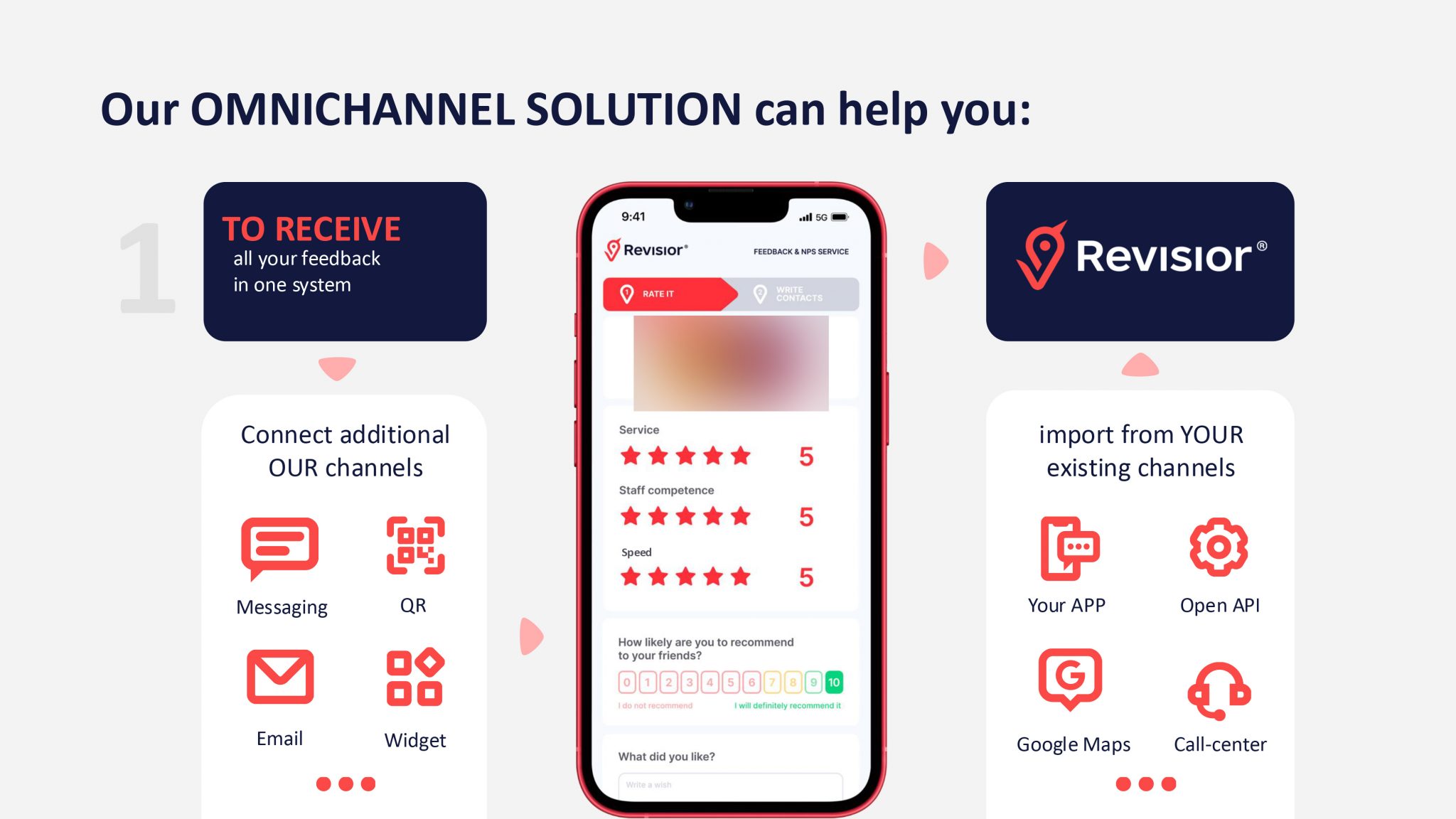
Customer satisfaction surveys remain a key tool for collecting quality feedback in modern business. With the development of digital technologies, companies are looking for solutions that allow quickly analyzing large volumes of reviews and effectively responding to consumer needs. The Revisior system offers flexible capabilities for automating the processes of collecting, processing and analyzing data in real time. Thanks to integration with various communication channels, such solutions facilitate building an effective strategy for improving service and increasing loyalty.
Overview of Revisior capabilities for various industries
Revisior covers over 15 industries, ensuring adaptability to the needs of retail, healthcare and the restaurant business. Reports are generated in 5 minutes after the survey is completed, which speeds up response times.
- Trade — tracking satisfaction at over 1,200 points
- Healthcare — monthly loyalty growth of up to 10%
Revisior allows setting up individual survey scenarios for each industry.
Integration with current business processes
Revisior's integration with CRM, ERP and messengers ensures seamless data exchange. Comparison table:
Tool |
Implementation time |
Automation |
Revisior |
1–3 days |
Full |
Outdated systems |
2–4 weeks |
Partial |
Automated survey distribution doubles the speed of feedback collection.
Benefits for a company from implementing an omnichannel system
An omnichannel system allows companies to reach up to 98% of the audience through SMS, Viber, email and QR codes.
- Reducing response time — to 30 minutes
- Increase in repeat purchases by 12%
- Unified analytics for all channels
- Flexible scenario configuration in each segment
Using an omnichannel approach ensures stable growth in customer satisfaction.
Conclusions: how to achieve sustainable growth through high customer satisfaction levels
Customer satisfaction level determines not only the current state of the business, but also its future prospects. After implementing modern solutions for collecting and analyzing reviews, a company gains a unique opportunity not just to respond to individual complaints, but to build a sustainable development strategy. It is precisely a systematic approach to managing customer experience that opens the path to long-term growth, increased competitiveness and strengthened reputation. Successful companies understand: without continuous work on service quality, it is impossible to ensure stable growth of the client base and revenue growth.
Systematic work with reviews — the key to success
The key factor of sustainable development is regular collection and analysis of reviews across various customer touchpoints. To achieve maximum effect, it is important not just to collect information, but to promptly implement changes based on it.
- Automated surveys after each purchase
- Fast response to negative ratings
- Open communication about implemented changes
Comparison of approaches to working with reviews:
Approach |
Result |
Systematic |
Loyalty growth of 18% |
Episodic |
Decline in repeat purchases of 7% |
Continuous work with reviews builds trust and promotes long-term customer relationships.
Quality analytics helps make the right decisions
Modern analytics allows identifying non-obvious problem areas and finding growth points. Many Ukrainian companies note that it was precisely deep analysis of reviews that allowed them to optimize processes and increase customer satisfaction levels. Visualizing data through dashboards and graphs makes decision-making fast and evidence-based.
- Regular analysis of NPS, CSAT and CES metrics
- Identifying trends using heatmaps
- Developing specific service improvement plans
For example, companies that analyze satisfaction dynamics every month record a noticeable increase in repeat visits over the course of a year.
Deep analytics transforms the array of reviews into a valuable resource for strategic business development.
Start improving customer satisfaction with Revisior today
Start improving customer satisfaction with Revisior today — it is a simple way to make service more effective and competitive. By implementing digital solutions you will be able not only to respond quickly to reviews, but also to systematically improve service quality. According to Revisior data, companies using the platform record customer satisfaction growth of up to 30% within the first year. Integrate modern tools and gain an advantage right now — process automation saves time and resources, directing efforts toward business development.
Attract new customers and retain existing ones
Revisior helps not only to maintain the loyalty of current clients, but also to attract new ones through service transparency. The platform allows tracking the dynamics of customer returns and analyzing the reasons for their choices. Based on observations, consumers more readily choose companies with high satisfaction ratings. Below is a comparative effectiveness table:
Indicator |
Without Revisior |
With Revisior |
Average percentage of repeat purchases |
35% |
55% |
Number of new customers per month |
+8% |
+18% |
Using Revisior allows increasing loyalty and stimulating organic growth of the customer base.
Get service analytics in a convenient format
Revisior provides access to deep service analytics in the form of convenient dashboards, allowing decisions to be made based on real data. All key metrics such as CSAT and NPS are displayed in a clear form, simplifying the analysis of trends. According to a survey of platform users, 87% of managers noted an increase in problem response speed after implementing Revisior. Main analytics advantages:
- Instant access to current indicators
- Comparison of results over periods
- Identification of service weak points for prompt response
Quality analytics is the key to stable improvement of customer experience and increased company profitability.
FAQ
This section contains answers to the most common questions about measuring and improving customer satisfaction levels, as well as using modern tools for collecting and analyzing feedback. Find out how to effectively organize processes, choose the right metrics and implement automation to improve service.
How to properly conduct a customer satisfaction survey?
To conduct a survey effectively, it is worth developing clear and concise questions, following a clear logic. It is important to choose the most convenient channels for customers, for example email or chatbots. Timely feedback after the survey increases trust and encourages participation in future research.
What are the main indicators used to evaluate consumer satisfaction?
The most common metrics are CSAT (Customer Satisfaction Score) and NPS (Net Promoter Score). They allow quickly finding out how satisfied customers are with the service and whether they are ready to recommend the company to others. Using these indicators helps compare results over time and across various divisions.
How often should customer satisfaction levels be measured?
The optimal frequency depends on the specifics of the business, but surveys are usually conducted after key interaction points or quarterly. This allows timely identification of changes in consumer expectations and prompt response to problems. Measurement regularity ensures a more accurate picture of loyalty dynamics.
What are the advantages of an omnichannel approach to collecting feedback?
An omnichannel approach allows reaching a wider audience, as customers can choose a convenient channel for providing feedback. This increases the level of engagement and ensures a multifaceted analysis of impressions. As a result, the company receives more complete data for making strategic decisions.
How to use survey results to improve service?
Survey results should be promptly analyzed and transformed into specific actions — for example, improving processes or training staff. It is important to inform customers about the changes implemented to show that their opinion is genuinely taken into account. This promotes increased trust and loyalty.
How does Revisior differ from other feedback collection services?
Revisior provides flexible automation of feedback collection and analysis processes in real time and supports integration with various channels. Thanks to this, the company can quickly respond to changes in customer expectations and timely implement improvements. The service also offers convenient visualization of results.
How does automation help in processing customer reviews?
Automation allows promptly collecting, structuring and analyzing large volumes of feedback without unnecessary time expenditure. This reduces the human factor impact and increases the accuracy of customer satisfaction evaluation. Thanks to automated solutions, the company identifies problems faster and responds to them.