In today's competitive market, companies are competing not for the act of purchase itself, but for long-term customer experience. Brands with a strong product but weak service quickly lose trust, while companies with a well-designed customer journey build loyalty that surpasses any marketing budget. That is why customer service quality has become one of the key business strategies for international brands.
A telling example of such a systematic approach is the Pandora case — a global leader in the accessible luxury category that transformed customer feedback into a service scaling tool.
Pandora: a brand where service equals emotions
Pandora is not just jewellery. It is a brand that sells personal stories, emotions and symbols, and every interaction with a customer has value. The company operates in more than 100 countries worldwide, has 6,700+ sales points, a powerful online ecosystem and an extensive partner network.
To maintain the same service standard at a global level, the company must:
- control interaction quality at thousands of touchpoints;
- respond quickly to negative feedback;
- understand local characteristics of customer behaviour;
- find the strongest practices and scale them.
And most importantly — have data to make decisions not intuitively, but based on real processes in stores.
Problem: complications in service control during scaling
A developed network is not only an opportunity, but also a challenge.
Over time Pandora encountered a typical problem for global companies:
Lack of detail in data
Reports showed overall satisfaction levels but did not allow understanding:
- in which location the problem arose;
- exactly which stage of interaction was causing difficulties;
- which team is showing the best indicators;
- why certain regions receive a lower NPS level.
The company could only see the "tip of the iceberg," while operational decisions required depth.
Theoretical basis: why service control without data is an illusion
In the field of Customer Experience (CX), three key approaches are identified:
1) Measurability of every stage
The customer journey consists of dozens of "moments of truth":
consultation, fitting, purchase, checkout, call, delivery, warranty, support.
If a company does not measure these stages separately — it is not managing service, but merely reacting after the fact.
2) Closed-Loop Feedback
This is the international standard for building service. It provides for:
- collecting feedback in real time;
- automatic classification of reviews;
- prioritization of critical cases;
- personal contact with the customer;
- analysis of causes and updating standards.
Without a closed loop, feedback becomes "collecting reviews for the sake of reviews."
3) Omnichannel Experience
The customer expects equally high service quality:
- in the physical store;
- in the online store;
- in a contact centre call;
- in post-sales support.
If one channel "sags" — the whole brand suffers.
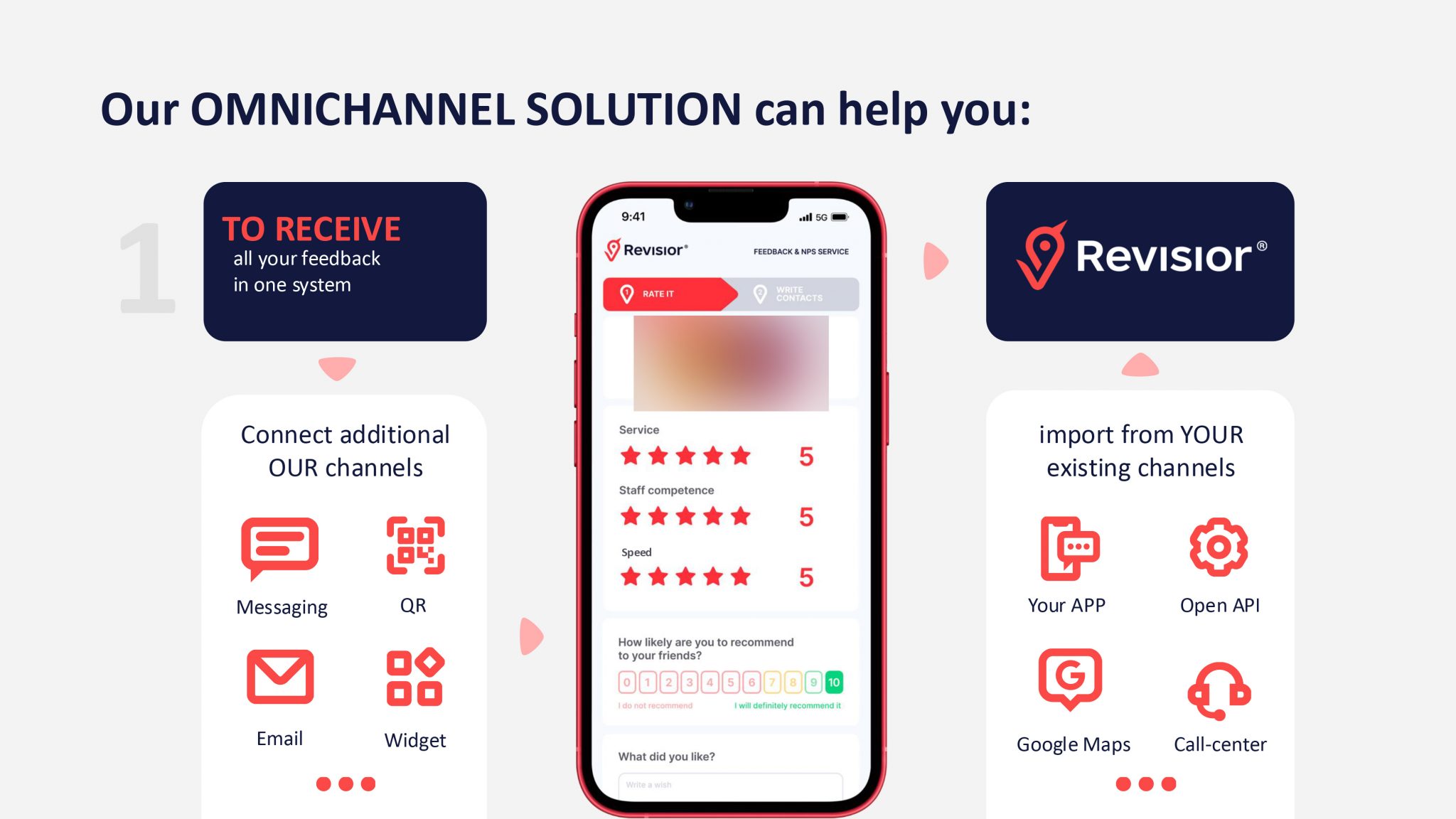
That is why Pandora turned to Revisior to build a complete feedback ecosystem that works across all channels — automatically, at scale and predictably.
Solution: an omnichannel service quality control system
Together with Revisior, the brand implemented a comprehensive system covering all customer touchpoints.
1. Unique QR infrastructure and location hierarchy
For hundreds of stores, individual QR codes were created that are automatically linked to a specific location.
What this provided:
- management sees separate indicators for each city, store and team;
- managers can quickly identify the problem;
- the company forms a location ranking by NPS and service quality;
- the strongest practices are scaled to other locations.
This is the first step towards data-driven service management.
2. Integration with POS fiscal system: transforming the electronic receipt into a feedback channel
The buyer receives an electronic receipt in the app or by email — and with it a link to a survey.
This allows:
- covering 100% of buyers;
- receiving feedback after every purchase;
- saving on SMS costs;
- forming data on service quality even without staff involvement.
In effect, every purchase became an initiator of customer experience.
3. Automation via CRM and Open API
Revisior integrated with Pandora's CRM via Open API, which allowed:
- launching triggered surveys;
- collecting feedback via Viber/SMS without manual actions;
- working with inactive clients;
- collecting data on each segment.
This made the feedback collection process continuous and personalized.
4. Phone service control via Phonet
After every call the customer receives a micro-survey: "How do you rate the consultation?"
This provides:
- prompt identification of communication errors;
- the ability to track the work of each manager;
- motivation to improve service through positive reviews.
This way Pandora obtained a complete picture:
offline + online + contact centre = unified service analytics.
Strategic and economic advantages for Pandora
1. Reduction of marketing costs
By switching to automated communication channels, Pandora was able to replace expensive SMS with electronic receipts and triggered messages.
2. Increasing LTV and reducing Churn Rate
When negative feedback is handled immediately, the customer doesn't have time to go to a competitor.
Research by ProofCX shows:
a customer whose problem was resolved quickly has a 70% higher probability of a repeat purchase.
This was fully confirmed by the Pandora case.
3. Data instead of assumptions
The system allowed:
- seeing service dynamics by region;
- identifying recurring problems;
- predicting customer behaviour;
- reinforcing staff strengths.
4. Strengthening corporate culture
Positive reviews in real time became part of internal motivation.
Employees see the results of their work and feel the significance of their personal contribution.
Results: numbers that speak for themselves
Thanks to the implementation of Revisior, Pandora achieved:
- growth in the number of reviews from 100 to 3,500 per month;
- NPS increase of 4.1 points;
- reduction in complaint response time by 4 times;
- minimization of customer churn through prompt feedback handling;
- building a unified service control system at the national level.
Practical recommendations for companies that want to replicate Pandora's success
1. Use omnichannel feedback collection touchpoints
QR codes, electronic receipts, phone calls, online checkout — every channel matters.
2. Implement SLA on response speed
A response to a negative within 30 minutes is the standard that forms premium service.
3. Automate prioritization of negatives
AI and review classification help save up to 70% of managers' time.
4. Don't collect reviews "to put in a drawer"
Returning to the customer with a solution is the key part of Closed-Loop Feedback.
5. Use feedback as a staff motivation tool
Positive ratings become "fuel" for team culture.
Conclusion
The Pandora case proves that customer service quality is a measurable, manageable and predictable process.
Revisior's omnichannel feedback system allowed the brand to build transparent, scalable and effective customer service based on data.
«We now have a complete picture of service — from the first purchase to post-sales interaction. This allows us to work with each customer individually», —
Olena Masliuk, Personnel Development Specialist at Pandora
If you want to create the same service control system that works automatically and delivers real business results, the Revisior team is ready to help.