Staff training and development
In modern business, staff training is not an additional option, but a strategic necessity. Companies that systematically invest in employee development achieve higher productivity, better service and a stronger brand. Staff training directly affects the quality of customer interactions, the efficiency of internal processes and the company's market competitiveness.
A systematic approach to staff training allows not only transferring knowledge and skills, but also forming a culture of continuous development. It is precisely this culture that becomes the foundation for long-term company growth, talent retention and stable service quality.
What is staff training?
Staff training is a systematic process of developing employees' knowledge, skills and competencies that helps them perform their duties more effectively and adapt more quickly to changes in the business. It is an important part of human resource management that directly affects company results.
In modern companies, staff training fulfils several key functions:
- improves the quality of customer service and service level;
- accelerates the adaptation and onboarding of new employees;
- reduces the number of errors in daily work;
- improves internal business processes and team interactions;
- forms a talent pool and prepares employees for new roles.
Regular staff training makes the company more flexible: the team masters new tools, standards and approaches faster, and the business is less dependent on individual key people.
Who needs staff training
The need for staff training usually becomes apparent through several signs: an increasing number of errors, new employees taking a long time to reach the required level, falling service quality or negative customer reviews. These are signals that teams lack knowledge or skills, and these need to be systematically developed.
Staff training is relevant for companies of any size — from small teams to large chains. It brings the greatest benefit where the quality of employees' work directly impacts revenue and reputation:
- Retail and e-commerce — service standards, handling objections, product knowledge.
- HoReCa — service, speed, handling guest reviews.
- Healthcare and clinics — patient communication, protocol compliance.
- Finance and services — product knowledge, service culture, compliance.
- Manufacturing and maintenance — safety procedures, technological standards, mentoring.
Regardless of industry, staff training delivers maximum effect when it is tied to real business metrics and built on data rather than intuition.
Types and formats of staff training
Modern companies use various formats of staff training depending on the tasks, budget and business specifics. Most often they are combined to cover different types of knowledge and skills.
Training format |
Description |
When effective |
Internal training |
Conducted by company staff: mentors, internal trainers, corporate standards |
Onboarding, transferring unique processes |
External training |
Trainings, courses and certifications from external providers |
New competencies, expert topics |
Online training |
Digital platforms, video courses, LMS |
Scaling, remote teams |
Offline training |
Seminars, workshops, practical trainings |
Skills requiring practice and interaction |
Self-learning |
Materials library, access to courses at a convenient time |
Motivated employees, soft skills |
The optimal staff training model usually combines several formats — for example, online theory with offline practice and in-team mentoring.
Staff training methods
The effectiveness of staff training depends not only on content, but also on the methods of its delivery. Different methods work better for different types of knowledge — theoretical, practical or behavioral.
- Mentoring — an experienced employee transfers knowledge to a newcomer directly on the job.
- Trainings — interactive skill practice in a group.
- Case method — analysis of real situations and finding solutions.
- Role-playing games — simulating work scenarios, especially in sales and service.
- Microlearning — short 5–10 minute modules for regular absorption.
- Practical tasks — applying knowledge to real challenges.
Combining several staff training methods helps better absorb information and immediately apply it in practice, which increases the real return from training.
How to build a staff training system
A staff training system is a comprehensive approach to organizing the training process in a company. Unlike one-off trainings, a system makes training predictable, measurable and tied to business goals.
A complete staff training system includes:
- training planning and identifying competency needs;
- creating training programs and materials;
- conducting training in chosen formats;
- evaluating results and impact on indicators;
- continuous improvement of programs based on feedback.
Integration with LMS
LMS (Learning Management System) is a platform for learning management. LMS integration makes the staff training system transparent and manageable:
- centralized management of all courses and materials;
- tracking progress of each employee;
- creating individual learning paths;
- automatic collection of training results data.
Automation of the training process
Automation allows scaling staff training without proportional cost growth. Automation systems enable:
- launching and assigning courses automatically;
- collecting completion and results data;
- generating reports for managers and HR;
- analyzing the effectiveness of each program.
As a result, the company gets not a set of disjointed trainings, but a managed staff training system that works toward business results.
Evaluating the effectiveness of staff training
Evaluation of effectiveness is a critically important stage of staff training. Without measurement it is impossible to understand which programs work and which only waste the budget. Several approaches are used for evaluation:
- analysis of testing results before and after training;
- evaluation of changes in employee productivity;
- analysis of changes in behavior and quality of customer interactions;
- feedback from employees and managers;
- dynamics of customer reviews and service level.
Collecting and analyzing this data allows linking staff training to specific business metrics — customer satisfaction, conversion, repeat sales — and making decisions based on facts.
Current trends in staff training
The field of staff training is actively developing, and companies that adopt modern approaches gain a tangible advantage. Among the key trends:
- Personalized learning — individual paths for the role and level of the employee;
- Artificial intelligence — content selection and results analysis;
- Microlearning — short regular modules instead of long courses;
- Gamification — points, ratings and rewards for motivation;
- Data-driven learning — program decisions are made based on real metrics.
Common to all trends is the movement toward data: modern staff training is built on measurable results and feedback, not on assumptions.
Why Revisior for staff training
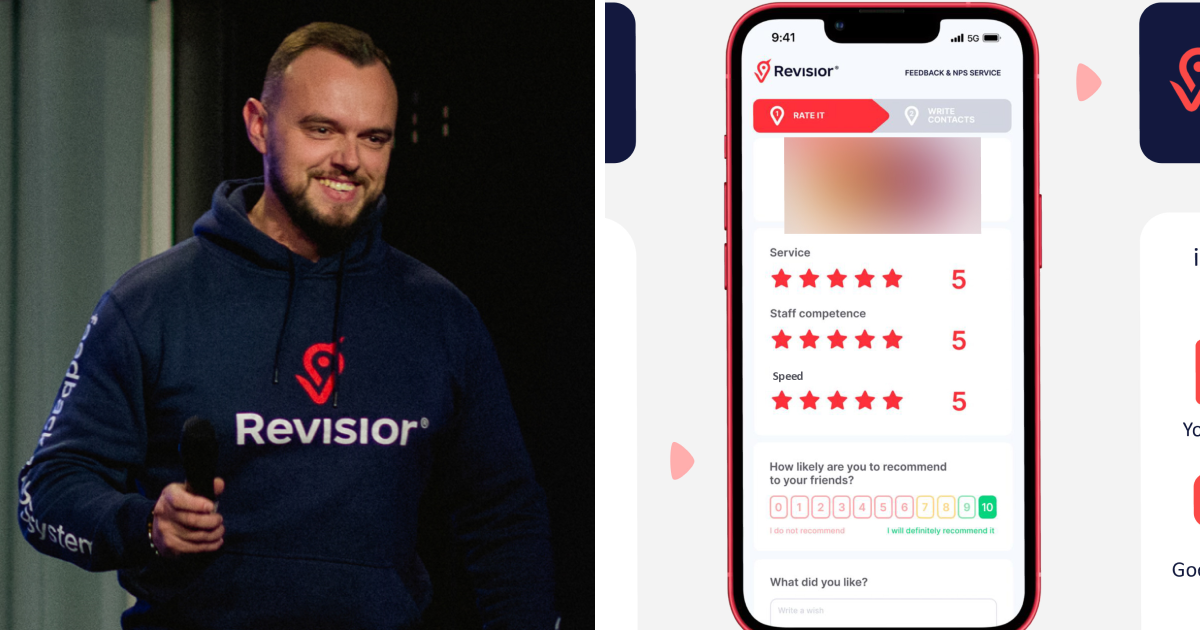
Revisior helps companies build staff training based on data — collecting feedback from all touchpoints, analyzing it and improving employee development programs. Instead of training "blindly," the business can see how training actually affects service and customer experience.
Task |
Without data |
With Revisior |
Identifying weak points |
Intuitively, with a delay |
Based on real feedback |
Training evaluation |
Difficult to measure |
Analytics and reports on results |
Training budget |
Risk of ineffective spending |
Investment in programs that work |
Service quality |
Without feedback |
Continuous monitoring and improvement |
Collect feedback from the whole system
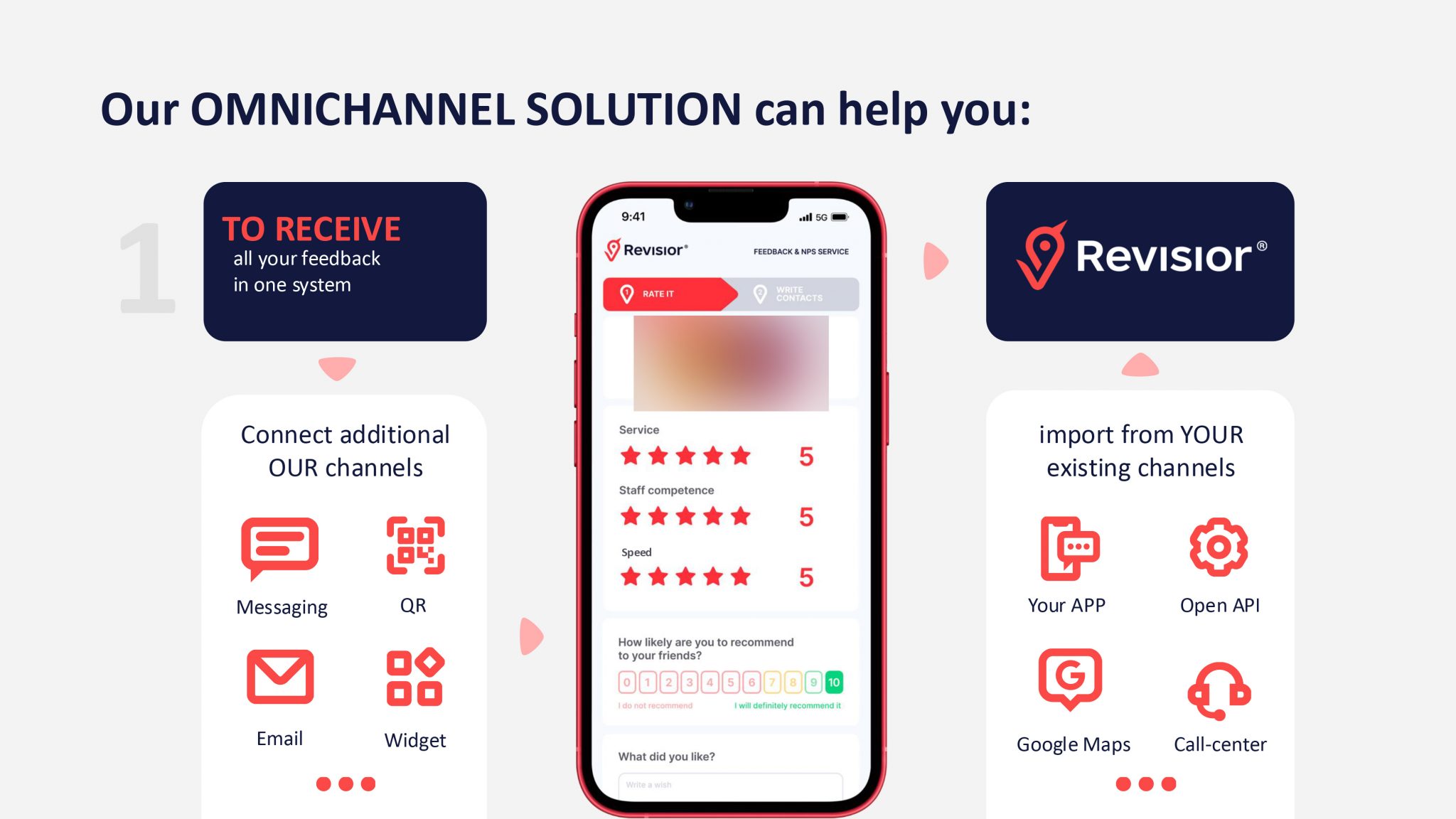
Revisior allows collecting feedback from various touchpoints — after training, after customer interactions and after completing courses. This gives a complete picture of how much staff training actually affects the quality of work.
Detailed analytics of the training process
The service provides analytics of collected data, clear reports and recommendations. This allows making fact-based decisions and systematically improving staff training rather than repeating ineffective programs.
Industries Revisior works with
Revisior is used by companies from various sectors — retail, e-commerce, healthcare, HoReCa and finance. In each of them, quality staff training and working with feedback directly affect revenue and customer loyalty.
Benefits of Revisior for staff training
Budget optimization
Thanks to data, companies can optimize training spending, invest in effective programs and avoid training that produces no results.
Retaining and returning customers
Quality staff training directly affects customer satisfaction, repeat sales and loyalty — and therefore income stability.
Positive reputation and referrals
Companies with well-trained staff receive better reviews, build a strong brand and attract new customers through referrals.
Stages of implementing staff training
For staff training to produce results, it is worth implementing it in stages rather than launching it chaotically. A step-by-step approach helps avoid unnecessary costs and immediately ties training to business goals:
- Needs audit — determine which competencies and skills teams currently lack.
- Goal-setting — formulate which business indicators training should improve.
- Program development — select formats, methods and materials for specific tasks.
- Launch and support — conduct training, provide mentor support.
- Analysis and adjustment — evaluate results and refine programs based on data.
This cycle makes staff training a continuous improvement process, where each iteration builds on the results of the previous one.
Common mistakes in staff training
Even with a budget in place, staff training often fails to deliver the expected effect. Most often the reason lies in typical mistakes:
- training "for the record," without connection to real tasks;
- absence of results evaluation and impact on indicators;
- identical programs for everyone instead of personalization by role;
- ignoring feedback from employees and customers;
- one-off trainings instead of a continuous development system.
Most of these mistakes are resolved when staff training is built on data: the company sees what works and what doesn't, and adjusts programs in time.
Conclusions
Staff training and development is the foundation of effective business. A systematic approach to staff training allows increasing employee productivity, improving service, reducing costs and growing revenue.
Using modern tools and working with feedback helps companies build effective training systems and achieve stable growth. The sooner a company transforms staff training from a set of one-off trainings into a managed system, the faster it will see returns in the form of better service and more loyal customers. Start improving staff training today — find out how Revisior will help you collect data, analyze results and build an effective employee development system.
Frequently asked questions about staff training
What is staff training in simple terms?
It is a systematic process in which a company develops the knowledge, skills and competencies of employees so they perform their work better. Staff training covers onboarding of newcomers, skills upgrading and forming a culture of continuous development.
What are the main formats of staff training?
The main formats are internal and external training, online and offline formats, as well as self-learning. Most companies combine them: for example, online theory via LMS, offline practice at workshops and in-team mentoring.
How to evaluate the effectiveness of staff training?
Effectiveness is evaluated by testing results, changes in productivity, employee behavior and customer feedback. The most accurate method is to link training to business metrics: service level, conversion and repeat sales. Tools like Revisior allow doing this based on real data.
How often should staff training be conducted?
Frequency depends on the industry and the pace of change, but staff training is more effective as a regular process rather than a one-off event. Microlearning and short regular knowledge updates generally deliver better results than infrequent large trainings.